


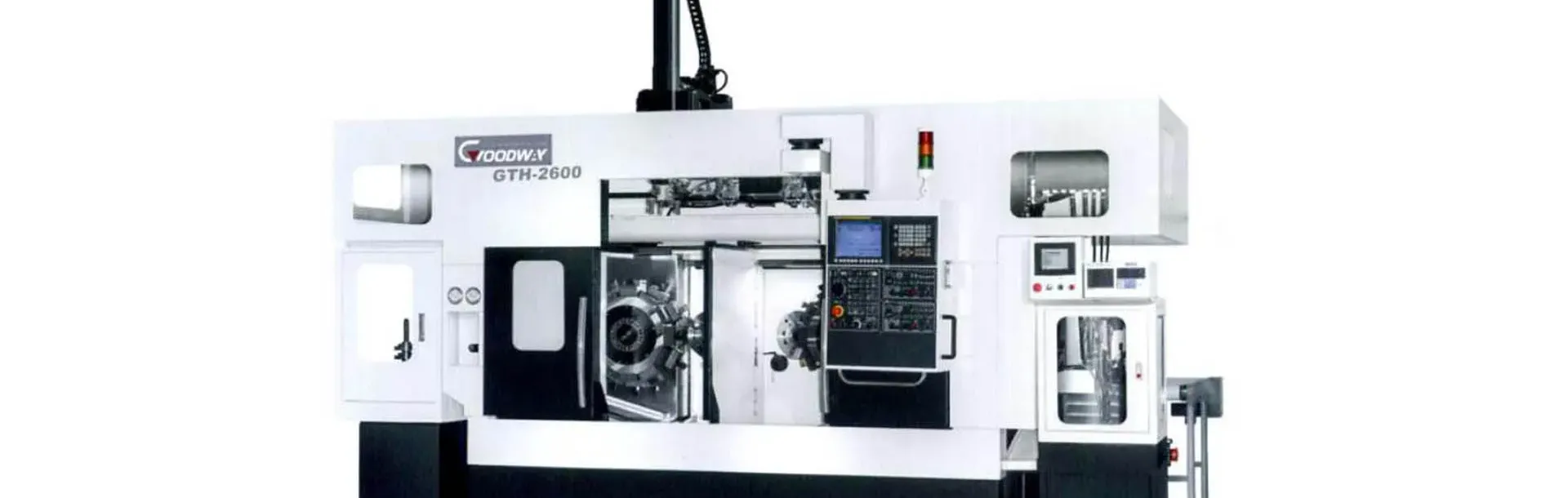
CNC lathes are machine tools used to manufacture mechanical components by removing material from a rotating workpiece. The workpiece is secured in a chuck and rotated by the spindle, while cutting tools follow programmed movements to perform the required operations.
These machines are widely used to produce shafts, bushings, pins, flanges and many other industrial components. Depending on their configuration, they can perform conventional turning operations as well as combined drilling and milling tasks.
CNC lathes are available in horizontal, vertical and multi-axis configurations, with different structures and machining capacities. Understanding how they work and the differences between each type helps manufacturers select equipment suited to their production requirements.
What Is a CNC Lathe?
A CNC lathe is a machine tool whose movements are managed by a Computer Numerical Control system.
The operator prepares the machining program, sets up the cutting tools and checks the conditions required to run the cycle. The CNC system then controls axis movements, spindle speed and the other functions available on the machine.
The defining feature of turning is the rotation of the workpiece relative to the cutting tool. This process can produce cylindrical, tapered, flat and threaded surfaces, as well as grooves and other geometries compatible with the lathe’s capabilities.
On a conventional lathe, many movements are controlled manually. A CNC lathe allows the machining cycle to be programmed and repeated, making it particularly useful when producing multiple components with the same specifications.
How Does a CNC Lathe Work?
The CNC turning process can be divided into four main stages.
- Workpiece preparation. The material is secured in the chuck or another suitable clamping system. Long components may require additional support, such as a tailstock.
- Programming. The operator creates or loads the CNC program, which defines toolpaths and machining parameters. The installed tools and their offsets must be checked before the cycle begins.
- Machining. The spindle rotates the workpiece while the cutting tools remove material according to the programmed sequence. The turret can change tools when different operations are required.
- Part inspection. The finished component is checked against the dimensions and tolerances specified in the technical drawing. Process adjustments can be made when necessary.
Consider the production of a metal bushing. A CNC lathe can machine its external diameter, produce or finish the internal bore and complete the front surfaces. If the component also requires a thread, that operation can be included in the machining program.
Once the cycle has been prepared and verified, the machine can repeat the sequence for subsequent workpieces. Loading and unloading remain manual unless the lathe is equipped with a dedicated automation system.
What Machining Operations Can a CNC Lathe Perform?
The available operations depend on the machine’s structure, installed tooling and axis configuration.
The main CNC turning operations include:
- External turning to produce cylindrical diameters, tapered surfaces and shaped profiles.
- Internal boring to machine and finish existing holes in the component.
- Facing to machine the front surfaces of a workpiece.
- Threading to produce internal and external threads.
- Grooving and parting-off to create grooves or separate a finished part from the original material.
- Axial drilling using cutting tools and equipment compatible with the machine.
Some CNC lathes can also perform milling, off-centre drilling and machining operations on several faces of the component. These functions require suitable equipment, such as driven tools and additional axes.
A standard two-axis CNC lathe therefore does not necessarily offer the same machining capabilities as a multi-axis turning centre.
What Are the Axes of a CNC Lathe?
The axes determine the movements that a CNC lathe can perform. Most conventional CNC turning configurations use the X and Z axes, while more advanced machines may also include C and Y axes.
| Axis | Function | Typical application |
|---|---|---|
| X | Radial movement of the cutting tool relative to the workpiece. | Machining diameters and profiles. |
| Z | Tool movement along the spindle axis. | Longitudinal turning and facing operations. |
| C | Controlled angular positioning of the spindle. | Positioning and coordinated machining with driven tools, where available. |
| Y | Additional transverse movement relative to the X and Z axes. | Off-centre milling, drilling and other complex operations. |
The differences become clearer when comparing two BLIN CNC lathe configurations.
The BLIN BL-H50T features X and Z axes and a hydraulic turret. It is designed for the main turning operations.
The BLIN BL-H50Y, on the other hand, includes C and Y axes and a driven-tool turret. This configuration allows additional operations requiring coordinated movements and rotating cutting tools.
The number of axes should be chosen according to the geometry of the components being produced. For mainly cylindrical parts, an X/Z configuration may be sufficient. When production regularly involves off-centre drilling or milling, additional axes can reduce the need to transfer workpieces to other machines.
What Are the Main Types of CNC Lathes?
CNC lathes can be classified according to spindle orientation, machine structure and available machining operations.
Horizontal Slant-Bed CNC Lathes
Horizontal CNC lathes have a horizontally oriented spindle. In a slant-bed configuration, the tool movement systems are mounted on an inclined structure, generally improving chip evacuation and access to the machining area.
These machines are widely used to manufacture shafts, bushings, pins, flanges and other mechanical components.
The slant-bed CNC lathes available from Skio Macchine include models with hydraulic turrets, driven tools and additional axes, depending on the selected configuration.
Flat-Bed CNC Lathes
Flat-bed CNC lathes feature a traditional longitudinal structure and are also suitable for machining long or large workpieces.
In these applications, the distance between centres, turning diameter and workpiece support systems are particularly important.
A workshop manufacturing long shafts may consider flat-bed CNC lathes, comparing the machining capacities of the available models.
The bed structure alone does not determine a machine’s accuracy or productivity. Performance also depends on construction quality, guideway systems, tooling and machining conditions.
Vertical CNC Lathes
In a vertical CNC lathe, the spindle axis is vertical and the workpiece is generally mounted on a horizontal rotating table.
This arrangement is particularly suitable for large-diameter and heavy components, including rings, flanges and substantial industrial workpieces.
The loading arrangement can make heavy components easier to position, although appropriate clamping systems are still required.
Vertical CNC lathes are therefore worth considering when workpiece size and weight make a horizontal configuration less practical.
Multi-Axis and Multitasking CNC Lathes
Multi-axis CNC lathes provide additional movements beyond standard X/Z turning. Depending on the model, they may include driven tools, C and Y axes, a sub-spindle or multiple turrets.
These configurations can combine several machining operations on the same machine, reducing workpiece transfers and the number of separate setups.
A multitasking lathe can be particularly useful when a component requires both turning and milling or drilling operations.
Multi-axis capability does not define a separate machine structure. A multi-axis lathe can also be a horizontal slant-bed model.
Which CNC Lathe Should You Choose for Your Workpieces?
Machine selection should begin with the characteristics of the components being manufactured, before considering optional equipment.
Some typical applications include:
- Bushings, pins and small shafts produced in series. A horizontal slant-bed CNC lathe may be suitable, with automation options depending on production volumes.
- Long shafts and components with substantial longitudinal dimensions. A flat-bed CNC lathe may provide the required machining length and support configuration.
- Heavy flanges and large-diameter rings. A vertical CNC lathe can make workpiece positioning and machining more practical.
- Parts requiring off-centre drilling and milling. A lathe equipped with C and Y axes and driven tools may complete multiple operations without transferring the workpiece to another machine.
These examples provide an initial guide. Final suitability must be checked against the specifications of the individual model and the intended machining conditions.
What Is the Difference Between a Conventional Lathe and a CNC Lathe?
On a conventional lathe, the operator directly controls many of the tool movements and machining settings.
On a CNC lathe, the machining sequence is programmed and managed by the numerical control system. Once the program has been prepared and checked, the machine can repeat the required operations on multiple components.
CNC control is particularly useful for repetitive machining, complex profiles and the ability to reproduce an established machining cycle.
Conventional lathes still have a role in many workshops, including certain one-off jobs, repairs and operations that do not require the preparation of a CNC program.
In both cases, the final accuracy depends on machine condition, tooling quality, workpiece clamping and the correct setup of the machining process.
What Specifications Should You Check Before Buying a CNC Lathe?
Once the type of lathe has been selected, its machining capacity must be checked against the dimensions and characteristics of the intended workpieces.
The most important specifications include:
- Maximum turning diameter, which must be distinguished from the swing over bed.
- Maximum turning length, taking into account the tailstock and any tooling restrictions.
- Spindle bore and spindle specifications, particularly for bar-fed production or specific clamping requirements.
- Number of axes and turret configuration, to determine which machining operations are available.
- Installed CNC control, considering programming requirements and the workshop’s existing systems.
- Automation options, especially for repetitive production or machining cycles requiring limited operator attendance.
A technical drawing of the component, together with information about the material and production quantities, helps assess machine suitability more accurately.
New and Used CNC Lathes for Industrial Manufacturing
Skio Macchine supplies new and used machine tools for industrial metalworking, including different CNC turning configurations.
Our range of new CNC lathes includes models designed for conventional and combined turning operations, with different machining capacities and equipment options.
Companies considering second-hand equipment can also explore the available used machine tools, checking the specifications and condition of each machine.
If you are looking for a CNC lathe for your workshop, you can contact Skio Macchine with details of your workpiece dimensions, required operations and expected production quantities. This information helps our team identify suitable models and the equipment required for your manufacturing needs.


