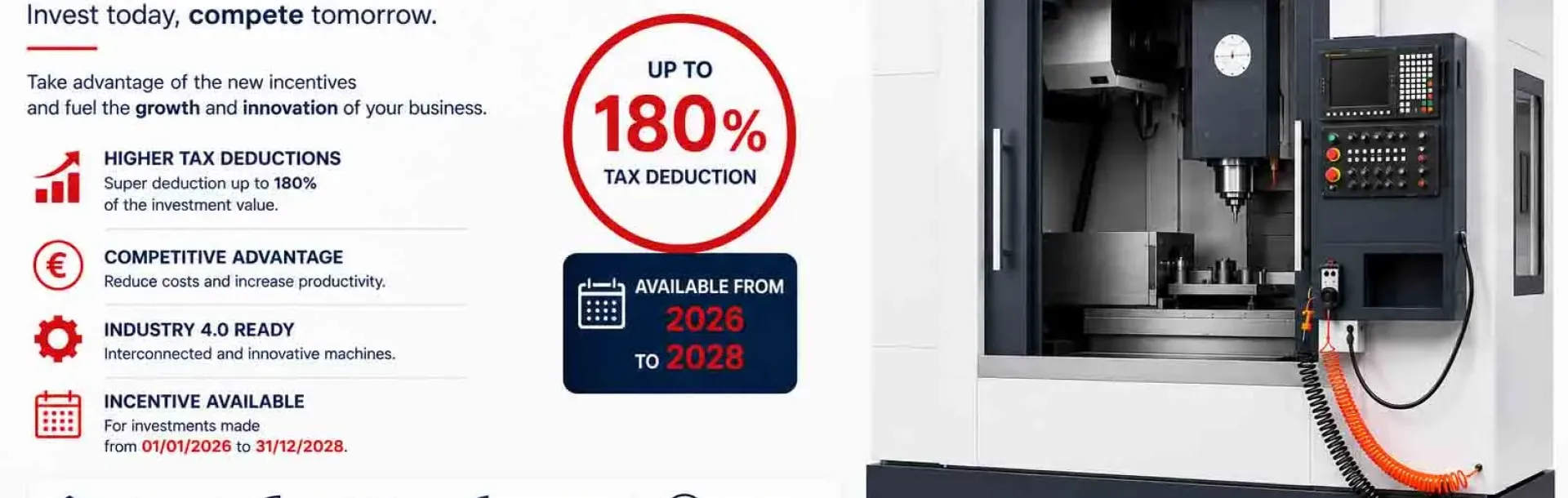
The incentive landscape for capital goods in Italy has undergone a radical transformation. Starting in 2026, the traditional tax credit mechanism for Transition 5.0 has officially been replaced by the New Hyper-Amortization scheme (Iperammortamento), a structural measure active for the 2026-2028 three-year period.
Timing for investment planning is crucial: the official platform of the GSE (State Energy Services Manager) opens for fund reservations today, Friday, June 12, 2026. For international machinery manufacturers exporting to Italy and multinationals with Italian production facilities, understanding these operational rules is essential to secure the incentive.
From Tax Credit to Super-Depreciation: What Changes
The main updates concern the fiscal instrument itself. Instead of accumulating a tax credit for offset, companies apply a 180% step-up in the asset’s fiscal cost for investments up to €2.5 million. This translates into a drastic reduction of the taxable corporate income (IRES), yielding an effective corporate tax saving of 43.2% on the machinery value.
Here is a summary table to map out the shift:
| Incentive Parameter | Previous Transition 5.0 | New Hyper-Amortization 2026-2028 |
|---|---|---|
| Fiscal Instrument | Tax Credit (F24 Offset) | Step-up Depreciation (Tax Deducion) |
| Machine Tool Rate | Variable based on energy saving | +180% to €2,5M (~43% IRES tx saving) |
| Green Conditionality | Mandatory (Energy reduction) | Confirmed in continuity with 5.0 energy goals |
| GSE Platform Opening | Legacy Portal | Friday, June 12, 2026 |
What are the technical requirements for Transition 5.0 in machine tools?
To qualify a machine tool (e.g., CNC machining centers, lathes, milling machines, presses, or laser cutting systems) for the New Hyper-Amortization 2026, the investment must simultaneously fulfill two mandatory pillars: the 4.0 digital paradigm and the 5.0 energy efficiency framework.
1. The Digital Pillar (Factory Interconnection)
The machine tool must strictly comply with the digitization requirements outlined in the Italian Law 232/2016 (former Annex A):
- Numerical Control: Integration of latest-generation CNC or PLC systems.
- Interconnection: Bidirectional data exchange with factory IT infrastructure (e.g., ERP or MES software) for sending work instructions and part programs.
- Automated Integration: Automated logistical tracking or connection with the factory network and other machinery in the production cycle.
- Human-Machine Interface (HMI): User-friendly screens and systems ensuring safe and intuitive operation.
- Safety Compliance: Strict alignment with current European machinery directives and safety standards.
2. The Energy Pillar (Green Conditionality)
Being “smart” is no longer enough; the machine must also significantly reduce energy consumption compared to the previous setup. The innovation project must guarantee:
- A minimum 5% reduction in energy consumption for the specific target production process where the machine tool is integrated.
- Alternatively, a minimum 3% reduction in overall energy consumption for the entire local production facility.
The Bureaucratic Process to Access the New Incentive
To secure the incentive and prevent application rejections by control authorities, the purchasing company must follow a strict chronological procedure:
- Ex-Ante Certification: An independent certified engineer, expert, or certified ESCo must calculate baseline consumption and estimate the actual energy savings the new machine tool will deliver.
- GSE Portal Booking: Starting today, Friday, June 12, 2026, project data and the initial certification must be uploaded to the platform to reserve the financial resources.
- Ex-Post Certification: Upon complete installation and interconnection, a second technical audit must validate the actual energy savings achieved on the factory floor.
- Invoicing Traceability: Invoices from the machine tool builder and delivery notes must explicitly display the regulatory references for the New Hyper-Amortization 2026 and the unique project identification codes issued by the GSE.
The switch to Hyper-Amortization stabilizes machinery incentives for the next three years. However, the rush to reserve funds on the portal requires immediate technical planning between manufacturing plants and their technology providers.